
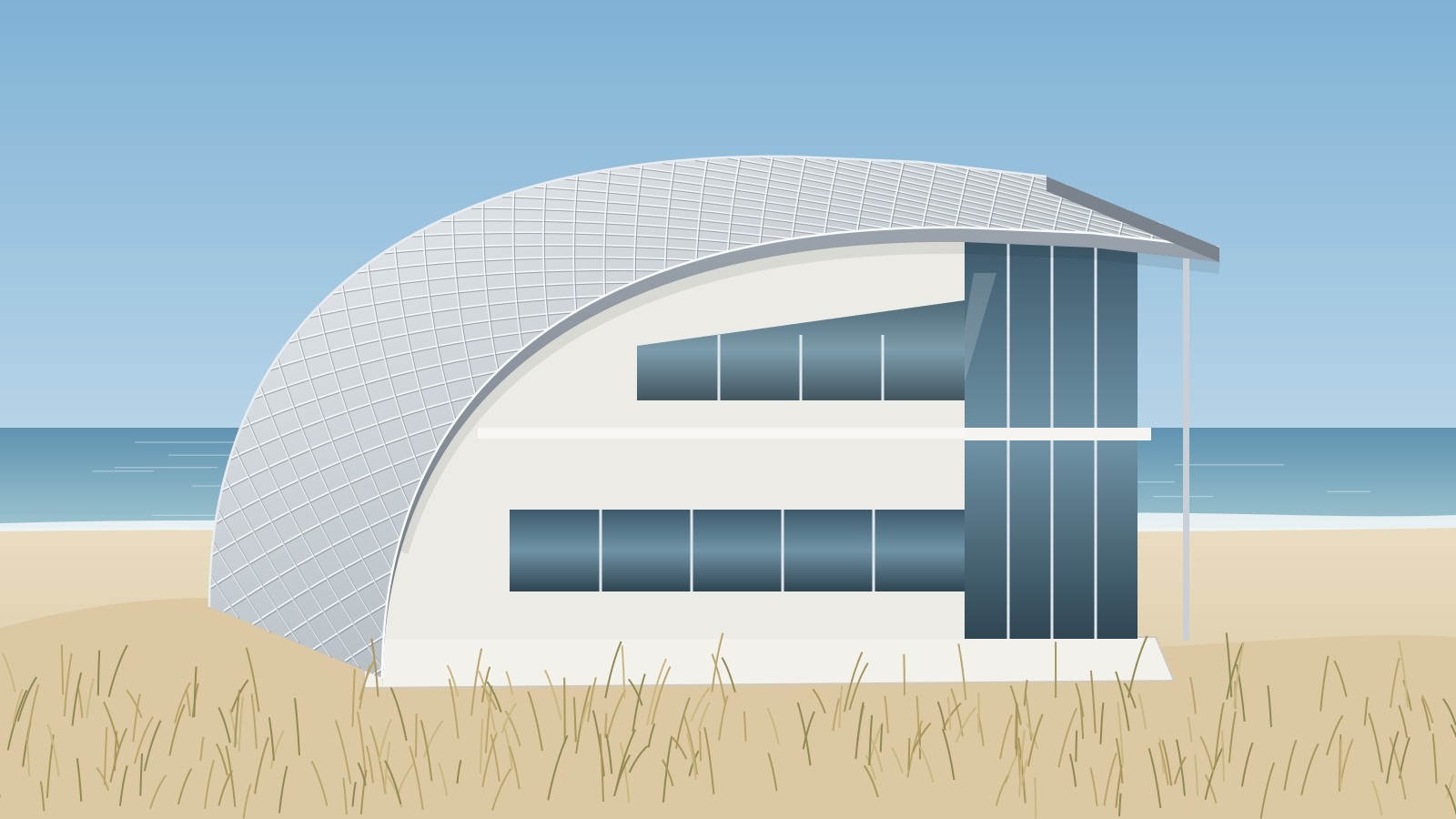
Curved metal roofing on an oceanfront home is one of the most striking things architecture can do. It is also one of the hardest things to build well.
Picture a beach house wrapped in a single metal shell. It rises out of the dunes as a wall, rolls over as the roof and reaches out toward the water. Every shingle follows the curve. Every edge faces wind, sand and salt spray.
Radius work and marine exposure are each among the toughest conditions in architectural sheet metal. On the coast, they arrive together. Here is what it takes to make a curved metal envelope last by the ocean, and what to ask before the first piece is formed.
What Curved Metal Roofing Really Takes
Flat sheet metal does not want to curve. Getting it to follow a radius cleanly, without waves, kinks or stressed joints, is shop work that starts long before anything ships.
Single curves and compound curves are different animals. A barrel roof or a curved wall bends in one direction. A shell like the one in this illustration curves in two directions at once. Long panels cannot follow that kind of surface, so it has to be broken into smaller pieces.
This is where diamond shingles earn their keep. Small-format metal shingles can follow compound curves that long panels simply cannot. Spengler fabricates each diamond shingle for its place on the curve, so the finished skin reads as one continuous form.
Measure what was actually built. Framing rarely lands exactly where the plans say it will. On curved work, small differences show up as gaps, waves and lines that refuse to run true. For that reason, good radius work starts from the real substrate as well as the drawings.
Give the metal room to move. Metal expands and contracts with every change in temperature. A curved surface moves differently than a flat one, so attachment and terminations must allow that movement without tearing loose or buckling.
There is no standard installation guide for radius surfaces. It is among the most advanced work in the trade, and it is the kind of work Spengler Industries was built for.
How the Ocean Attacks a Metal Roof
Salt air is relentless. Chlorides settle on every surface, pull in moisture and keep working on the metal long after a storm has passed. On the coast, the details decide whether a roof lasts for decades or starts failing in a few years.
- Match the material to the exposure. Coatings that perform well inland can struggle within reach of salt spray. Spengler offers a marine grade option for close coastal applications.
- Keep incompatible metals apart. In salt air, contact between dissimilar metals works like a battery, and the weaker metal loses. Flashings, fasteners and clips all have to be compatible.
- Use fasteners that outlast the roof. A fastener that rusts out takes the shingle with it. Coastal work calls for fasteners matched to the system and the site.
- Let water leave. Wherever salt water can sit, it concentrates and attacks. Drainage and ventilation matter as much as the visible skin.
- Protect the cut edges. Every cut exposes metal the factory coating no longer covers. Careful detailing keeps those edges from becoming the first place corrosion starts.
- Plan for wind. Oceanfront buildings take serious uplift, and curved edges and overhangs catch it. Attachment has to be engineered for the site.
Where Curved Metal Roofing Meets Salt Air
Radius work and salt air make each other harder. Every joint on a curved surface is a place where water can linger, and a compound curve has far more joints than a flat wall. Each piece cut to fit the curve adds another cut edge. Meanwhile, the overhangs that look effortless in a drawing are exactly where wind and spray hit hardest.
That is why curved coastal work cannot be value-engineered into a stock product. The shape, the joints, the attachment and the material have to be designed together. When that happens, the result is a building that looks like it grew out of the shoreline and stays that way.
Who Installs Your Curved Metal Roofing Matters
Perfectly fabricated shingles can still fail in the hands of a crew that has never worked a curve. Radius installation is a skill people train for years to learn. It cannot be picked up from a sheet of instructions on a deadline.
Spengler works in the German Spenglermeister tradition, where curved and complex metalwork is core training. On large or complex projects, we can send an experienced specialist to the site or train your installation team before work begins. Bringing us in early, at the design and specification stage, is the best way to make sure the curve in the drawings is the curve that gets built.
Planning a Curved or Oceanfront Project?
Whether it is a single curved roof or a full sculptural envelope on the water, Spengler Industries can help from early design through fabrication and installation support. We are a one-stop shop for the whole metal building envelope, roofing and wall cladding, with solutions for demanding environments and high-difficulty work.
Spengler Industries 5066 West Amelia Earhart Drive, Salt Lake City, UT 84116 801-462-5264 · [email protected] www.spenglerindustries.com