
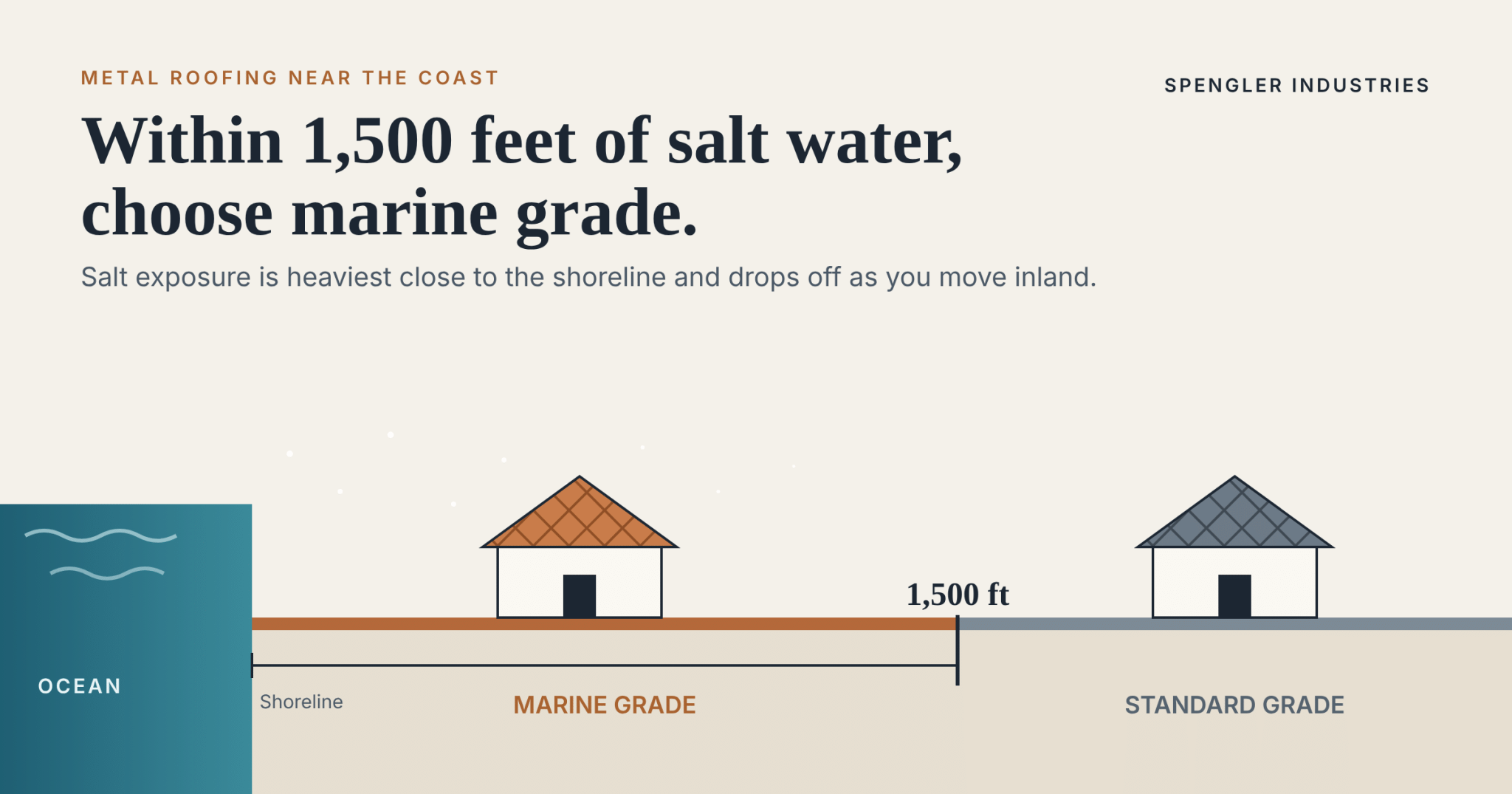
If your building sits within 1,500 feet of salt water, choose a marine grade metal roof. Beyond that distance, a standard grade system is usually the right choice. That’s our rule of thumb at Spengler Industries, and it’s how we guide clients choosing between the two grades of our diamond shingle system.
Here’s what’s behind that number, and what else to think about before you choose.
What salt air does to a metal roof
Near the ocean, the wind carries fine salt particles inland. They settle on every surface, and when they mix with humidity or morning dew, they form a film that keeps working on metal long after the sun comes out. The closer you are to breaking surf, the heavier that exposure gets.
A roof that would last for decades a few miles inland can wear much faster on the waterfront. The metal itself rarely gives out first. The trouble starts at the weak points: cut edges, fasteners, scratches from installation, and places where water and salt sit instead of draining away.
Why 1,500 feet
Salt exposure is heaviest in the first stretch of land behind the shoreline and drops off as you move inland. Within roughly 1,500 feet of salt water, a roof sees enough constant salt load that we recommend the added protection of our marine grade. Farther inland, our standard grade handles the conditions well.
Local conditions can shift that line. A building on an exposed bluff facing prevailing onshore winds may need marine grade a little farther back. One sheltered behind other structures may need it less. If you’re close to the line, talk to us and we’ll look at the site with you.
What marine grade changes
Our marine grade diamond shingle is built for heavier salt exposure, so it holds up where the standard grade would face a shorter service life. It looks the same as our standard grade, so you don’t give up the architecture to get the protection.
[WARRANTY: add a sentence here on how coverage differs between standard and marine grade near salt water.]
The details matter as much as the grade
A marine grade roof is only as strong as its weakest component. On a coastal project, we look at:
- Trim and accessories. Flashings, ridge caps and edge trim should match the roof’s grade. We supply coordinating components so the whole system stays consistent.
- Fasteners. The wrong fastener can fail long before the roof does. Use fasteners suited to coastal exposure.
- Mixed metals. Some metals react with each other when salt water is present. Keep incompatible metals apart.
- Sheltered areas. Rain washes salt off open roof surfaces. Areas under overhangs, behind parapets, or tucked into corners don’t get that rinse, so salt builds up there. Good drainage and an occasional fresh-water rinse help.
- Installation care. Scratches and cut edges are where corrosion starts. Careful handling and proper detailing at the edges pay for themselves near the coast.
Coastal and hurricane country
In Florida and along the Gulf and Atlantic coasts, salt air often comes with high winds. Our diamond shingle system has passed Miami-Dade hurricane testing, so a coastal project can meet wind requirements in the same system that handles the salt.
Frequently asked questions
Can I use a metal roof on a beach house?
Yes. Metal is an excellent choice near the coast when you choose the right grade and detail it properly. Within 1,500 feet of salt water, we recommend marine grade.
Does marine grade look different?
No. Our marine grade and standard grade diamond shingles share the same profile and appearance.
What if my building is right around 1,500 feet from the water?
Consider wind direction and exposure. If the site faces onshore winds or sits high and open, marine grade is the safer choice. We’re glad to help you decide.
Do I need special trim and fasteners too?
Yes. Trim, flashings and fasteners should be suited to the same exposure as the roof. We supply coordinating components for both grades.
Talk to us about your coastal project
Spengler Industries manufactures engineered architectural metal roofing and cladding in Salt Lake City, led by a master craftsman in architectural sheet metal, trained and certified in Germany. If you’re planning a roof near the water, [contact us] and we’ll help you choose the right system for the site.