
Asbestos shingle replacement is one of the harder problems on a historic roof. The diamond pattern is a big part of what makes the building look the way it does, and the shingles that created it have not been manufactured in decades. A reroof with ordinary shingles keeps the water out and erases the roof’s character in the same week.
There is a way to keep both. A painted metal diamond shingle reproduces the same diagonal grid, sits flat like the original, and gives the building a roof that should not need this conversation again for a very long time.
Why diamond asbestos shingles cannot be replaced in kind
Asbestos-cement shingles went into mechanized production in the United States in the early 1900s and stayed on the market into the 1980s, according to the National Park Service’s history of the material. The diamond layout, which the trade called the French or hexagonal method, was especially popular because each shingle needed very little overlap.
They were tough. Many of these roofs have been in service for the better part of a century. But the roofs still standing are now old. Shingles turn brittle and crack, fasteners corrode, and the underlayment beneath them wears out.
When that day comes, the owner finds there is nothing to order. No one makes the original product. That leaves a choice between a roof that looks nothing like the original and a different material that can carry the same pattern.
How metal diamond shingles match the original roof
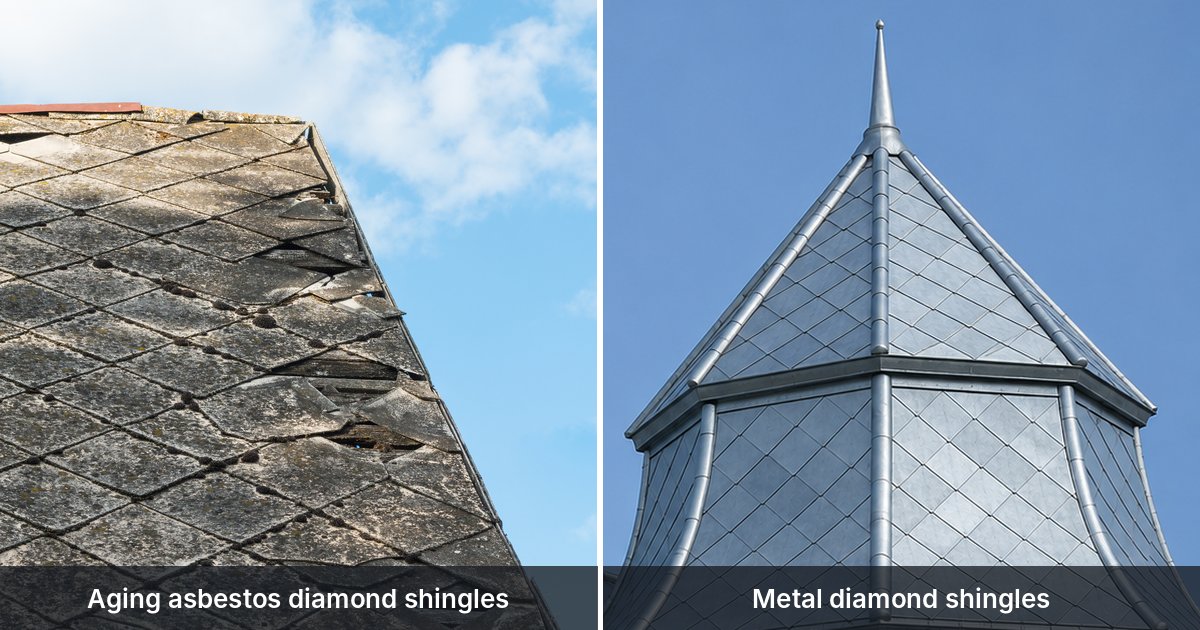
A diamond asbestos roof reads as a flat, crisp grid of squares set on their points. Three things make that look, and a metal diamond shingle can carry all three.
- Pattern. Our metal diamond shingles are laid point down in the same diagonal grid, with straight lines running up the roof in both directions.
- Scale. We fabricate in our own shop, so the shingle size can be set to match the exposure of the shingles coming off. Measure the originals before removal and we work from those numbers.
- Surface. The shingles lie flat and close to the deck, with a thin shadow line at each edge, much like the original. A low-gloss painted finish in gray, red or slate tones keeps the roof from looking shiny or new.
One detail from the history is useful here. The Park Service notes that many early red asbestos shingles faded to pink over the years. Decide early whether the goal is the color the roof was when it was built or the color the neighborhood has known for fifty years. Either is a fair answer, and a review board may have an opinion.
You can see the pattern on finished buildings in our metal shingle gallery.
Light on old framing, built to stay put
Asbestos-cement shingles were sold as a lightweight roof, and many historic buildings were framed with that in mind. Painted metal shingles are light as well, so the new roof does not ask old rafters to carry more than they were built for. Heavier lookalikes, such as real slate or concrete tile, often cannot make that promise.
Each metal diamond locks into its neighbors on all four sides. The fasteners are covered by the next course, so there are no exposed screws to back out or washers to dry up in the sun. The roof works as one connected surface instead of a collection of loose pieces.
We build these roofs to last for generations. A historic building should be restored once and then left alone to be enjoyed.
What preservation reviewers look for
If the building is in a local historic district, is using historic tax credits, or has state or federal money in the project, someone will review the new roof. That may be a local commission, the State Historic Preservation Office, or both.
Reviewers generally prefer the original material. When the original is no longer available, federal guidance leaves room for a substitute. The National Park Service lists unavailable historic materials among the situations where a substitute may be appropriate, and it judges the substitute on three main points:
- Appearance. Does it closely match the original in design, color, texture, finish and reflectivity?
- Physical compatibility. Will it get along with the historic materials around it?
- Performance. Will it last, and can it be repaired?
No product is approved in advance. Each building is reviewed on its own. What helps is showing up prepared: photos and measurements of the existing roof, a physical sample of the new shingle in the proposed color, and a small mock-up if the board wants to see the pattern at full size. We are glad to supply samples and drawings for that purpose.
Historic roofs in the desert Southwest
A lot of diamond asbestos roofs are in hot, dry country, where the conditions are hard on any roof.
- Heat and sun. Roof surfaces swing through wide temperature ranges every day. A roof made of many small interlocked shingles lets each piece move a little on its own, so expansion never builds up across a long run of metal.
- Monsoon wind. Summer storms arrive fast, with strong gusts and driving rain. Shingles locked on four sides give the wind no loose edge to lift.
- Hail. Brittle old shingles crack under hail. Metal does not shatter.
Tell us where the building is and how exposed the site is. We set the fastening and the details for the conditions the roof will actually see.
Removal is a separate job
Taking off the old shingles is work for a licensed asbestos abatement contractor. The rules for removal, handling and disposal vary by state and locality, and your abatement contractor and local building department are the right sources for them. We do not remove asbestos and do not advise on it.
Our part starts with the new roof. We fabricate the shingles, flashings and trim, and we support the installing roofer with details and consultation. The one thing worth planning together is the schedule, so the new roof is ready to go on as soon as the old one comes off and the deck is not left open to the weather.
What to send us for a quote
A good quote starts with a few simple things:
- Roof measurements or an aerial measurement report
- Photos of the roof, including valleys, ridges, dormers and edges
- The size of the existing shingles and how much of each one shows
- The color you are trying to match
- The building’s location
- Whether a historic commission or preservation office is reviewing the project
- Your timeline
Send those to our team and we will get to work.
Frequently asked questions
Can I still buy diamond asbestos shingles?
No. Production in the United States ended in the 1980s. Asbestos shingle replacement today means choosing a different material that carries the same pattern.
Will a historic commission approve metal diamond shingles?
That is decided building by building. Federal guidance allows substitutes when the historic material is unavailable and the replacement closely matches the original’s appearance. A sample and a mock-up make the case far better than a brochure.
Can the new shingles match the size of my old ones?
Yes. We fabricate to order, so the shingle can be sized to the exposure of the originals. Measure before the old roof comes off.
Does Spengler remove the old asbestos shingles?
No. Removal belongs to a licensed abatement contractor. We supply the new roof and support the roofer who installs it.
Can you ship to my state?
Yes. We fabricate in Salt Lake City and ship to projects across the country.